Total Pageviews

8/30/2021

About I.D.E.A.! Together we can! : Instituto comprensivo Giuliano Giorgi, Montorio Romano, Italy-Italian project team


About I.D.E.A.! Together we can!

There was no lack of opportunities for recreation and fun (many, in fact...) during our dinners or culinary-cultural exchanges, especially or during the bus journey between one place and another!!! Songs, games, dances... moments that will remain etched in the mind forever; visits to the most important cities in our countries: historical, archaeological and cultural sites where the vision of such beauty became a motivating force to continue the journey towards the discovery of different places and cultures, harbingers of knowledge and continuous learning.

A constant stimulus to open our local and national horizons towards the unknown world, rich in educational experiences, personal and community growth through the transmission of our own acquisitions upon return from each mobility. The exchange of good practices was an opportunity to meet new friends, to weave new and positive relationships between fellow travellers united by the desire to help those who, in their own path of growth, have greater difficulties.

The commitment of all of us has been to understand each other's needs and requirements, to embrace their difficulties (linguistic, physical, emotional, logistical, etc.) and to encourage them to continue their journey together. We have embodied our own motto: I.D.E.A.! TOGETHER WE CAN!!! This has united us and will keep us close in a bond that goes beyond the experience of a convention. The Erasmus + Project encompasses all the knowledge that passes through life experiences, which touch all the sensitive chords of the being.

Our senses allowed us to see, touch, hear, taste, smell in a deeper way, adding greater awareness to our actions, among adults and in the teacher-pupil relationship. The store of prior knowledge was greatly enriched, as were the relationships between all the members of the group. A unique experience!

Italian I.D.E.A project team


If I can prevent

a heart from breaking

I will not have lived in vain.

If I relieve the pain of a life

Or ease a pain

Or help a fallen robin

To return to its nest

I will not have lived in vain!

Today is far from childhood

But up and down the hills

I hold his hand tighter

that shortens all distances!

The feet of those who walk

towards home

go with lighter sandals!

(Emily Dickinson)


8/24/2021

Instituto comprensivo Giuliano Giorgi, Montorio Romano, Italy- Italian project team opinion at the end of project

European dimension of education

Extract from the REPORT OF THE COUNCIL (EDUCATION)

FOR THE EUROPEAN COUNCIL ON THE CONCRETE FUTURE OBJECTIVES

OF EDUCATION AND TRAINING SYSTEMS (Brussels, 14 February 2001):

1.3 Equal opportunities and social exclusion

Education and training are the structural means by which society can help its citizens to have equal access to prosperity, democratic decision-making and personal socio-cultural development. Access to lifelong updating of skills is therefore a key element in the fight against social exclusion and the promotion of equal opportunities in the broadest sense.

promoting equal opportunities in the broadest sense of the term. In this context, particular attention should be paid to vulnerable groups such as people with specific learning problems.

Education and training systems should aim to contribute to the creation of an inclusive society by ensuring that structures and mechanisms are in place to

eliminate discrimination at all levels.

To achieve this, a chain of improvements and implementation of resources, knowledge and techniques is needed:

Improving education and training of teachers and trainers

·      Ensuring access to ICTs for all

·      Facilitating access to all education and training systems

·      Opening up education and training systems to the outside world

·      Improving foreign language learning

·      Increasing mobility and exchanges

·      Strengthening cooperation at European level


European education systems in partners countries - our view

 Croatia: Croatia has inclusion, but there are also schools for children with special needs called Education Centers, and are specialized in specific types of needs such as the Center for Autism, the Center for Children with Disabilities, blind and visually impaired. Early Childhood Education and Care in Croatia is funded and managed by local authorities. Central educational authorities provide legislative guidance, accreditation and monitoring of the educational programs.

Primary education starts at the age of 6 or 7 and consists of eight years of compulsory schooling. Secondary education is not compulsory, but almost all students do enroll into secondary courses upon completing primary level. Depending on the curriculum, secondary schools are divided into:

 Gymnasiums (cover a general education and are mostly a transition to the professional training in colleges, universities and faculties) – 4 year programs,

 Vocational - 3 - 5 year programs

 Art schools (music, dance, art) - 4 year programs

Children with special needs in Croatia are educated in regular schools or in the centers for children with special needs. In regular schools they are included in general curriculum, with adjustments made to the subjects' contents and working methods in regard to the type and degree of disability. They can also follow general education curriculum in the centers but under special conditions or according to a special program. The decision about the type of the education system is made by a commission for determination of psychophysical condition of a child, with parents' consent. Exceptionally, in some regular schools there are special classes for children with developmental difficulties, in which children are taught by defectologists (special needs teachers).

In the Croatian mobility, we learned a new way of inducing concentration and implementing the attention span of pupils through brain gym. We were impressed by the effectiveness of this methodology. In the dissemination phase in our school, we were able to directly observe the benefits for individual pupils and for the whole class. The children are happy to experiment with new forms of "play" and let themselves be guided, with the end result being benefit and enjoyment. In the period following the brain gym, the children are better prepared for the activities presented and the activities are carried out with commitment, concentration, less wasted energy and better learning results.

.............................................................................................................. 

Slovenia: Slovenia has special education and mainstream schools. However, they also have integrated students with special need. Besides, Slovenia have education centers who are specialized in specific types of needs such as the Center for Cerebral Palsy, the Center for Children with Disabilities, Blind and Visually Impaired.

https://youtu.be/slZhc8FS7wM

Slovenian mobility has been food for thought on several fronts. First of all, we have had confirmation that contact with nature and with domestic animals brings us all back to a state of calm, of peace; it brings us into harmony with ourselves and with the world. This contact favours listening to our deepest emotions and feelings, a contact with ourselves and consequently favours the establishment of positive relationships with others, animals or people. The docility of animals allows the sweetness, calm and serenity of those who have made contact with them to emerge.

In Italy, many legal provisions relating to allergies, hygiene and therefore the health and safety of people prevent the practice of hippotherapy at school, leaving it up to personal initiative. Hippotherapy is widespread, as a practice through which the child's balance, muscle tone, coordination and motor awareness are worked on. It brings psychological-behavioural benefits: the main psychological benefit is the increase in self-esteem generated by the small responsibilities assigned to the child.

There is a strong impact on the philosophy that guides Halliwick's practice. The concept combines the area of mental and physical adaptation to water, relaxation, breathing control, balance and the acquisition of basic motor skills in the water. The Halliwick concept is based on the following: introduction to water, motor learning, holistic learning, awareness of abilities and achievements in the water instead of disabilities on land, improvement of the quality of life, integration of children and people with and without disabilities. Not just a simple and fun bath in water, but a process that leads the child to believe more in himself, forgetting the conditioning of a life based on contact with the earth. Water makes possible what the earth can make difficult if not impossible. Wow! A new way of interpreting reality and experience.

 ................................................................................................................

Poland: Education of pupils with special educational needs is an integral part of the Polish Education System. The Polish education system allows the choice between three options: mainstream schools, integrated schools and special schools. A need of special education is ascertained in a decision issued after a psychological and pedagogical examination is carried out by specialists from guidance and counselling center for youth and children. Special education is intended for children and young people with disabilities (physically disabled, incl. aphasia, intellectually disabled, blind, visually impaired, deaf, hearing impaired, autistic, incl. Asperger syndrome, with multiple impairments, with social maladjustment or at risk of social maladjustment who require special organization of teaching and learning processes and working methods). Every pupil with a statement of need for special education has his/her individually formulated educational and therapeutic program which is adjusted to his/her needs and psychological and physical abilities. Depending on the special educational needs and type of disability, pupils with disabilities attend special nursery schools, special primary schools, basic vocational schools and schools preparing for employment.

 During the Polish mobility, we had the opportunity to observe the use of BIOFEEDBACK THERAPY. We were struck by the effectiveness of the technology, which allows the students' emotions to be conditioned favourably so that they can understand, through images and colours, their emotional state and, if altered, bring it back into a positive, calm emotional phase. This methodology, if used extensively in all schools, could positively change the learning outcomes of many children with special needs, especially those with altered emotional states.

 ...........................................................................................................

Turkey: The Ministry of National Education (MoNE) conducts educational activities on a central level in the Republic of Turkey. Each level of education is made up of Pre-School, Primary and Lower Secondary, Upper Secondary and Higher Education. Education level in Turkey consists of preschool, primary, middle, secondary and higher education. 12 years education is mandatory for all students, every each level (primary, middle, secondary) takes 4 years to finish. There are programs for preschool, primary, middle, vocational and technic higher levels which based on education of person with special needs. Besides, there are special education institutions which implement special education programs for primary, middle and higher education levels.

What struck us about the Turkish Mobility was the paintings made by disabled children from one of the schools visited in Istanbul, all the manual-artistic works, made using different techniques, by children who are so fragile, but who convey such serenity. Some of the works in particular impressed us with their beauty and the serenity they conveyed. Considering that they were made by children with serious problems, they proudly showed us their hard work.

 ..............................................................................................................

Portugal: In Portugal the Public Education System is the most widely used and best implemented, although there are Private Schools at all levels of education. The school network is organized mainly in “Agrupamentos” (School Groups) that integrate educational establishments that provide all levels of education from preschool to secondary education. Education levels consist of preschool, elementary, intermediate and secondary - 12 years of mandatory education for all students - and higher education.

The Portuguese education system is very centralized, both in terms of organization and funding. However, preschool, elementary, intermediate and secondary public education establishments enjoy some autonomy, particularly at the pedagogical level, in the management of school hours and non-teaching staff.

However, new guidelines for curricular flexibility and greater autonomy have recently been published, and schools are implementing and developing new paths.

Public schools offer conditions for greater and higher equality of opportunities to all students. The City Council is also involved, as are other strategic actors such as Parents' Associations and Social and Local Institutions.

Since the Salamanca Declaration (UNESCO, 1994), Portugal is committed to develop an inclusive education. Therefore, all mainstream schools, at all levels of education, have integrated students with special needs that benefit from special programs according to their level of disability.

Currently, there is a Learning Support Center in every school that accompanies students who need help in their teaching-learning process. Furthermore, the Portuguese System includes Vision, Bilingual Education, and Early Childhood Intervention Reference Schools.

There are also Information and Communication Resource Centers and Resource Centers for Inclusion that provide supports in the selection of technological products, Speech and Occupational therapies, Psychology and in the development of Individual Transition Plans when students move forward to active life.

In the Portuguese mobility we were able to observe how the image can convey important messages through the use of a particular methodology of storytelling called KAMISHIBAI. Through the use of a simple tool, the botai, or the use of technology (video, ppt, ebook) to support children who have motor or language difficulties, we can work towards the goal of understanding a story by reading images.

We experienced the use of mandalas to unleash the children's creative powers: colours, materials and techniques for making them can be customised.

The children greatly appreciated the techniques learned, showing greater joy and involvement during the creation of the products.


Tilde Giacomelli

school coordinator

with school project team


8/10/2021

Diaries partners "school mates" - Janez - SLOVENIA, Antonio - PORTUGAL, Francesco - ITALY, Basia - POLAND, Jana - CROATI, Zeynep_Turkey

 Each partner made a doll, as large as 30 cm. The doll represented a "student". We created 3 girls and 3 boys: Slovenia, Italy and Portugal made boys, Turkey, Croatia and Poland made girls. Each country named its student with a typical national name, clothing were in the national spirit, studentdools traveled from one partner to the other. Each "student" wrote a diary, what he/she did when he/she was visiting his partner peers. Each school that hosts a particular student gave him, her a present at the end of the each trip ... something typical from the host country. The first trip began in Turkey, where we hand over the students to each other. Hand over took place as Slovenia passes to Turkey, Turkey -Croatia, Croatia - Italy, Italy - Poland, Poland – Portugal, Portugal - Slovenia. 

Diaries: 

School mate travell: https://padlet.com/AKozicka/v8m3cw6hwuclfmyv


5/31/2021

C6 SHORT-TERM JOINT STAFF ONLINE TRAINING EVENT IN SLOVENIA - “Integrating new learning methods into the learning process for students with SEN” - via Zoom platform.

17th May

There were 31 participants per day, from all partner countries: Italy, Portugal, Turkey, Poland and Croatia plus 11 slovenian teachers.

The Slovenian coordinator, and project’s main coordinator - Mrs. Tanja Nikolovski  - opened the virtual mobility by presentating the timeline for the first day. It was a moment of rejoice for seeing eachother again after so long time. Altough Whatsapp group had been filled with photos, memes, souvenirs from other physical mobilities to keep memory alive, this was the time and the place to officially work together again, we were all very excited and happy to be able to share this experience.

At 9.05 a.m. Mrs. Msc Lidija Marin, Dr. Ljudevita Pivka Ptuj School headmistress, gave her welcoming speech and some minutes later the Heart Beat Band, mentored by Mrs. Msc Jasna Veber Zazula, presented an original musical performance.

At 9.30 a.m. we enjoyed a carefully planned virtual walk around the school dr. Ljudevita Pivka Ptuj, hosted by Msc Lidija Marin, headmistress. The school is quite new and well equipped. It impressed the group.

Then, at 10.30 a.m. there was a presentation of the mobile service - individual additional professional assistance to students with learning difficulties in regular primary schools by Mrs. Aleksandra Serec Šijanec, special education teacher. The group was given a detailed explanation of how SEM teachers also help students in regular classes around town, therefore showing that support is given outside the special education schools. Not always an easy straightforward help but teachers try to do their best.

Afterwards, there was time for dialogue, from  participants’ questions we could infer that they were motivated and eager to learn more about the subject and how Slovenia supports inclusion.

And this was the motto for the presentation of the Slovenian school system by Mrs. Tanja Nikolovski. She introduced the topic and gave a detailed explanation through a planned digital presentation enriched by the use of informative vídeos of Slovenian Ministry of Education.

https://www.youtube.com/watch?v=rvUOaJjlBNs

https: //www.youtube.com/watch? v = yFYOMQrUhNU

https://www.youtube.com/watch?v=-CNZvkTYQ6w&list=PLpXqOJBPuT-nY6S7KpbvfWTU0iwHZzITm&index=6

At 12.30 a.m., time for IRIS Center presentation – a Center for Education, Rehabilitation, Inclusion and Counselling for the Blind and Partially Sighted and our host was Mrs. Katjuša Koprivnikar, headmistress. Also her presentation was very accurate, used lots of images to exemplify the work developed in there and thus, digitally, share what we were supposed to see physically. We learnt for example that the center has programs for individual or group work with blind or partially sighted children, further qualification of professional staff, of cooperation with parents/guardians of blind and partially sighted children, for development of inclusive environments. Again the goal was accomplished and this working group could clearly understand IRIS mediation work on the subject.


On 18th may, 

the second day of this e-mobility, we all gathered via Zoom at 9 a.m., to visit the Center for Education and Rehabilitation of Physically Handicapped Children and Adolescents, Kamnik, hosted by Mrs. Simona Rogič-Ozek.

A specialised center for education and rehabilitation of children and adolescents with motor impairments or chronic illnesses. Habilitation means primarily education, however it also comprises medical therapy and rehabilitation and the development of other areas, which are important for life. Their goals are to achieve a suitable educational level, positively influence the medical condition and achieve the highest possible level of independence and effectiveness in physical, intellectual and social functioning within the individual’s capabilities.

At 10.00 a.m. we visited CIRIUS center - Vipava Center for Education, Rehabilitation and Training Vipava hosted by Mrs. Tanja Princes, special education teacher.

And afterwards, it was time for the presentation of Hearing and Speech Center Maribor by Mrs. Alenka Werdoning. Founded in 1960 to teach speech skills to children with hearing impairments, it offers a variety of early educational programming: Day School for children as young as six weeks, Preschool, Full-Day Kindergarten/Transitional Kindergarten program, Summer programs, including camps for children through second grade

Children with and without hearing loss or speech/language delays can benefit from its inclusive classroom settings. All classrooms and activities at the Early Learning Center feature language and literacy enriched curriculum with small student to teacher ratios. The listening and spoken language based programs provide a superior educational foundation for all children.

The last presentation was of VDC Sožitja Ptuj- a care and work center that provides care, guidance and employment under special conditions for people with intellectual disabilities, and a housing unit, our host was Mrs. Petra Šuster.

Laster, the group attended the welcoming speech by  Mrs. Nuška Gajšek, the Mayor of the city of Ptuj. A friendly speech which praised the guiding principles of the project, its participants, the professionalism with which they developed it to foster sharing of good inclusion practices to be provided to people with special needs. She also wished for our physical presence in Ptuj, looking forward to meet us all in person. Finally, we viewed some vídeos about the city of Ptuj to get acquainted with its inviting beautiful landscapes, culture and people.

https://www.youtube.com/watch?v=ltAjxMuxeSc

https://www.youtube.com/watch?v=C-lX-gfnq0k&t=1s

https://www.youtube.com/watch?v=hiFrU99wIMc

On 24th may,

it was time for the third day of the e-mobility, again, everybody joined  Zoom platform at 9 a.m., to learn about the Halliwick Concept of swimming for disabled people.

Mrs. Tanja Knehtl, occupational therapist, introduced the topic and showed excellent examples of this type of aquatic therapy, we were shown some videos of a practical demonstration in the pool with children. This approach focus on people with physical and/or learning difficulties, motivates them to participate in water activities, to move independently in water and to swim.’  (IHA – Halliwick Concept 2000). The method started to develop in London, in 1949, by James and Phyl McMillan and is based on principles of hydrostatics, hydrodynamics and kinesiology. The first official course on Halliwick concept in Slovenia was in 1996 in Ljubljana. In Slovenia there are 15 Halliwick swimming centers and in this school, they started with the first Halliwick course in 2013, they now have 6 instructors and 2 leaders. After this presentation there was a moment for debate and share of opinions about this methodology. All group participated actively.

At 10.30 a.m., we attended another most expected presentation about Animal - Assisted therapy (AAT) - activities with a dog and students, presented by Mrs. Tanja Kaučevič, special education teacher. She told the group about the main rules to work with animals and then showed  videos of its practical implementation. All group mobilized their attention to this type of therapy that fosters interaction between children and dogs. We learnt that pets can reduce stress, anxiety and depression, ease loneliness, encourage exercise and playfulness, and even improve one’s cardiovascular health. Caring for an animal can help children grow up more secure and active. Pets also provide valuable companionship for older adults. But this is not so easy to accomplish, there are strict selection criteria both for animals and trainers. Not all dogs can be therapy dogs, there are specifics of temperament, obedience skills, relationship with the handler, and more which a dog needs, to be a successful therapy dog, both candidate therapy dog and handler have to be tested. And there were so many other interesting information that we learnt: the AAI – Animal Assisted  Intervention - includes animals that meet certain criteria and is designed to promote improvement in physical, social, emotional and/or cognitive functioning of the person(s) involved; the R.E.A.D. for PET – dog assisted reading. R.E.A.D. ® (Reading Education Assistance Dogs), a licensed program registered with Intermountain Therapy Animals USA.

At 11.45 a.m. we were ready for the presentation of activities with the  HORSES  and  children with SEN which Mrs. Tamara Tomašič, special education teacher, carefully told us about. It was very interesting to see how these type of therapies actually are being implemented and how natural environments are being used for child development.

Last but not least, a bit of culture, therefore, the group was challenged to bake a tradicional dessert called Potica; Mrs. Tina Majerič, home economics teacher, and her students showed us, step by step, how to do it and now… it’s up to us to literally get our hands on the dough!

At 13.15 p.m. took place the closing event – a performance by students under the guidance of Mrs. Aleksandra Serec Šijanec, Mrs. Klementina Korpič Mikec, Mrs. Dragica Emeršič, Mrs. Vesna Horvat. A real magic moment that prepared our hearts for the end of this e-mobility.

However, every single heart was overwhelmed, even swept away, by the sincere words of the project coordinator. Those words made us feel the affection and the friendship that was forged throughout the 3 years project work, all the collaboration, commitment and joy put in every single activity, talk, performance, exhibition or stroll in each partner’s town, always with a smile and a warm friendly and caring attitude on our faces! Always together on the road!

 Together we did it! Together we  can! That’s the I.D.E.A.!


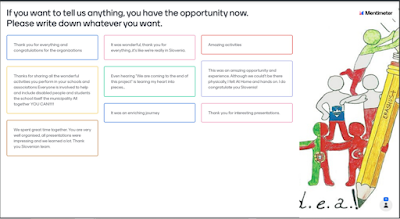
Opinions of participants on the implemented virtual mobility in May 2021 in Slovenia


4/26/2021

12th Short-term joint staff online training event - BEING INCLUSIVE IN THE 21STCENTURY, Agrupamento de Escolas de Aver-o Mar Povoa de Varim, Portugal


Being inclusive in a XXIst century educational system: the Portuguese field of experiences Inclusive education means that all children-no matter who they are-can learn together in the same school.


TUESDAY 23.03.2021. - BEING INCLUSIVE IN THE 21STCENTURY

 -School Hymn

- Welcome speech–headmaster Mr. Carlos Sá

- Ice Breaking: partners’ presentation

- School Guided Tour: by student’s from 8th grade

- Presentation of the Portuguese school system and Special Education procedures upon 54 and 55 Laws and Students National Profile by psychologist Mrs. Ana Prata

 - “OnceUpona Time…” -a KamishibaiStory Workshop I: -KamishibaiStoryTelling, Kamishibai workshop practice:


TUESDAY 13.04.2021 - REAL WORKING WORLD

 -Welcome speech by Town Hall Vice President and Culture Councilor:

 Mr. Luís Diamantino

- Vídeo tour to Póvoa de Varzim

- Online visit to CAO (Occupational Activities Center), Residential Home, Detached Homes and CEP (Protected Employment Center) in Terrosovillage, Póvoade Varzim

Workshop II: Art’Elier-Mandala’s


THURSDAY 22.04.2021BEING INCLUSIVE AT SCHOOL

 - Videotour to Porto and Braga

- Aver-O-Mar’sLearningSupportCentre (CAA): best practices and inclusive strategies

- “Aver-O-Mundo” Inclusive and intercultural project (within the scope of FAMI -Asylum, Migration and Integration Fund)

- Partner’sworkshops videopresentations

- Evaluationquestionnaire

- FarewellVideo

.................................................................................................................

Due to the outbreak of the COVID-19 pandemic Croatian and Italian teachers were not able to travel to Portugal in March 2020 to learn about Portugal’s education system and the forms of education for students with developmental difficulties.

To make up for that we had three-day-long virtual activities in the 2020-2021 school year.

The activities started on 23 rd March 2021.

 Portuguese 8 th grade students introduced us to their school buildings and facilities through a video presentation.

 Ms Ana Prata, the school psychologist, gave a lecture on the legal framework of education of children with developmental difficulties and the inclusion in regular schools.

Then we saw a presentation of the Japanese theatre Kamishibai, a form of storytelling with the aid of illustrations. Each participating school got the assignment to prepare their own Kamishibai story for the final activity of the mobility.

The second day of the activities was 13 th April 2021.

 We were greeted by Mr Luis Diamantino, the Mayor of Povoa de Varzim, who also led us on a virtual sightseeing tour of that small Portuguese town and tourist destination.

Then we learned about the Centre for Vocational Education and Practice for students with developmental difficulties.

After that we had an art workshop to make mandalas.

The final, 3rd day of virtual activities was 22 nd April 2021.

We learned about the Centre for Inclusion Strategies whose role is to support teachers working with and schools attended by students with developmental difficulties.

As the final activity, all of the schools that participated in the virtual mobility, presented their versions of Kamishibai theatre.